News & Insights · 1 June 2026 · 8 min read
Time Bars and Condition-Precedent Notices: Why Courts Enforce Them and How Not to Lose Your Claim
Australian courts enforce notice time bars literally. Treat notices as a commercial system, not paperwork, or watch entitlement evaporate.

The cheapest way to lose a million-dollar claim is to miss a notice. Not to lose the argument on delay, not to be out-gunned on quantum — simply to put the right claim in the wrong envelope, or the right envelope in the post a week too late. Australian courts have been remarkably consistent on this point for three decades: where a contract makes a notice a condition precedent to entitlement, the notice requirement will be enforced as written, even where the outcome is harsh and the underlying merits are strong.
For commercial teams on live projects, that consistency is actually useful. It means the rules of the game are knowable. The contractors who lose entitlement to time bars are rarely the ones who didn't understand the law — they are the ones who didn't run a system.
What a time bar actually is
A time bar is a contractual provision that extinguishes or bars a claim unless a notice or claim document is given within a stated period, in a stated form, with stated content. The strongest form is the condition precedent: language making a compliant notice a precondition to the entitlement itself. Typical drafting says the principal "shall not be liable" or the contractor "shall have no entitlement" unless notice is given within, say, a number of business days of the event or of when the contractor became aware of it.
The distinction matters. A bare procedural requirement ("the contractor shall give notice of delay") may sound similar, but a breach of it typically sounds in damages, if anything. A condition precedent, by contrast, operates as a guillotine: no compliant notice, no claim. Whether a clause is one or the other is a question of construction, but Australian drafting has trended steadily toward express, unambiguous conditions precedent — and courts take the parties at their word.
Standard forms are not a safe harbour. AS 4000-family contracts contain layered notice obligations around delay and extension of time, and the amended versions that actually get signed on Australian projects almost always tighten them — shorter periods, prescribed content, express condition-precedent language, and "no waiver except in writing" provisions to close off arguments based on conduct.
Why courts enforce them — even harshly
The leading Australian authorities leave little room for optimism about a sympathetic reading.
In CMA Assets Pty Ltd v John Holland Pty Ltd [No 6] [2015] WASC 217, the Supreme Court of Western Australia held that compliance with the subcontract's notice provisions was a condition precedent to the subcontractor's claims, and enforced the bar even while acknowledging the result was harsh. The reasoning is the orthodox position: the parties allocated risk deliberately, and the function of a notice regime — giving the other party the chance to investigate, mitigate, verify and price the event while it is still live — is defeated if claims can surface months later.
That functional justification goes back further. In Australian Development Corporation Pty Ltd v White Constructions (ACT) Pty Ltd (1996) 12 BCL 317, Giles CJ Comm D treated contractual notice machinery as a deliberate, bargained-for part of the contract's claims architecture, not a technicality to be read down.
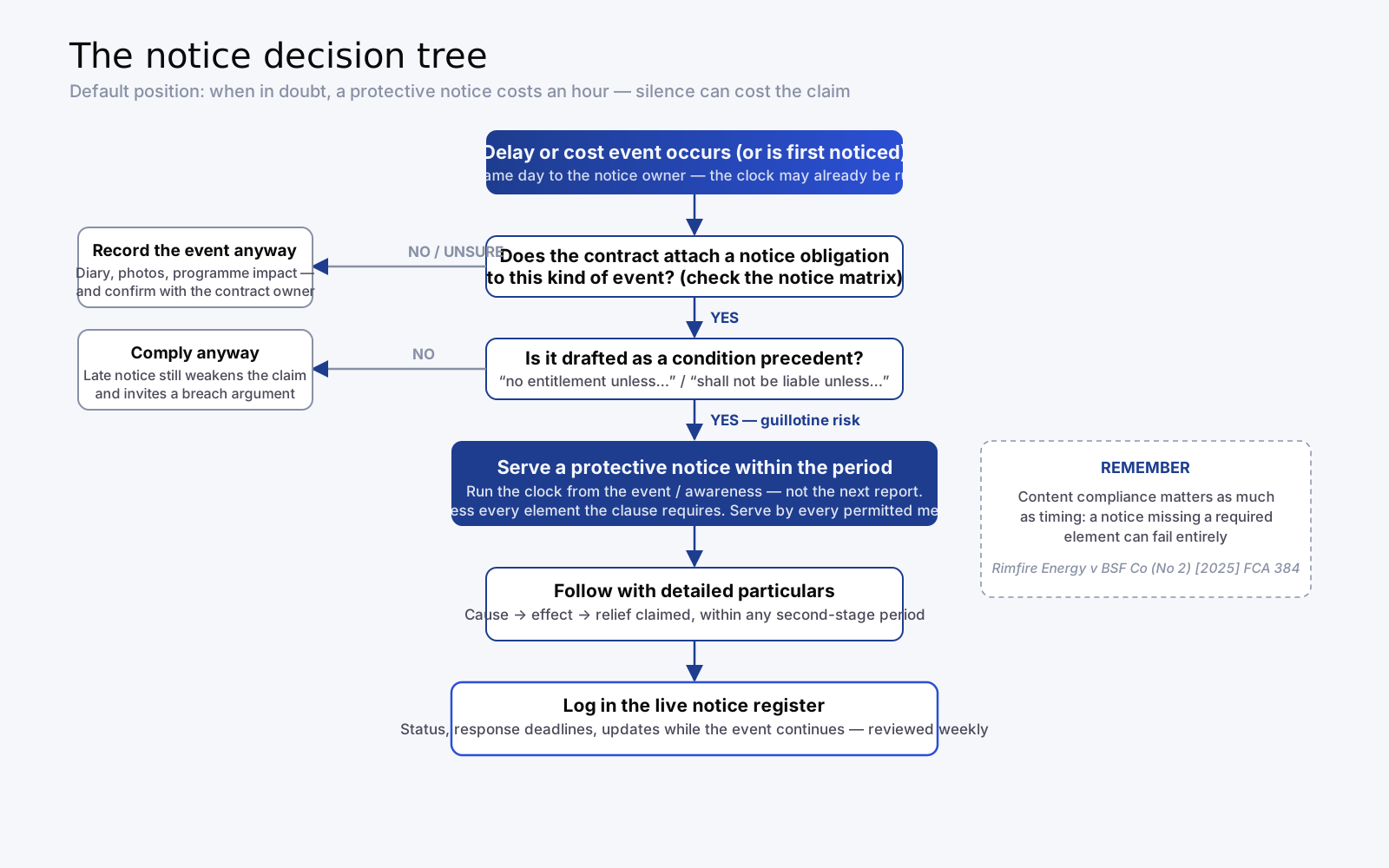
If you want a current illustration of how literal the analysis gets, the Federal Court's decision in Rimfire Energy Pty Ltd v BSF Co Pty Ltd (No 2) [2025] FCA 384 is sobering. Extension-of-time notices under a renewable energy agreement failed because they did not address an element of the contractual definition — in substance, the notices did not establish that the delay was not caused by the party claiming it. The consequence of those drafting omissions was the loss of substantial claimed extensions, leaving the claiming party exposed to delay damages. The lesson is that content compliance matters as much as timing: a notice served on time but missing a required element is not a compliant notice at all.
The escape routes are narrower than people hope
Three arguments get raised against time bars on Australian projects, and two of them usually fail.
The prevention principle. The argument runs: the principal caused the delay, so it cannot hold the contractor to the completion date (or take liquidated damages) arising from its own act of prevention. The difficulty is Turner Corporation Ltd v Austotel Pty Ltd (1994) 13 BCL 378, where Cole J held in effect that a contractor which has an extension-of-time mechanism available to it, and fails to use it, cannot then invoke the prevention principle. The contract gave it the remedy; it let the remedy lapse. The Northern Territory decision in Gaymark Investments Pty Ltd v Walter Construction Group Ltd [1999] NTSC 143 went the other way on unusual drafting — liquidated damages failed where the principal-caused delay met a time-barred EOT regime — but Gaymark has been repeatedly doubted and distinguished, and no commercial team should plan a project around it.
Unconscionability, waiver and estoppel. These depend on the other party's conduct, are heavily fact-specific, and run straight into "no waiver" and "entire agreement" clauses. They are litigation arguments, not commercial strategies.
The superintendent's reserve power. This one has real content. In Peninsula Balmain Pty Ltd v Abigroup Contractors Pty Ltd [2002] NSWCA 211, the New South Wales Court of Appeal held that where the superintendent holds a unilateral power to extend time, that power must be exercised honestly and impartially — and may fall to be exercised in the contractor's favour even where the contractor's own EOT notice is time-barred. Many amended contracts now try to neutralise Peninsula Balmain by stating the discretion is for the principal's sole benefit. Read yours; the answer changes claim strategy.
One genuine shift deserves a flag: under Victoria's security of payment reforms, which commenced in April 2026, adjudicators have power to disregard certain notice-based time bars found to operate unfairly in the adjudication context. That is a meaningful change for progress-payment disputes on Victorian projects — but it applies only in proceedings under the Victorian security of payment regime, and it is untested. It does not repeal the law of conditions precedent, and it is no reason to relax notice discipline anywhere.
Notices are a system, not a reflex
The pattern in the decided cases is striking: entitlement is rarely lost through ignorance of the law. It is lost because awareness of the event, ownership of the notice obligation, and the contractual clock were never connected in one place. The fix is administrative, cheap, and boring — which is precisely why it works.
What this means in practice
- Build a notice matrix at contract award. Before the first shovel: extract every notice obligation — trigger, period, addressee, delivery method, required content, and whether it is expressed as a condition precedent. One page per contract. Every amended AS 4000 or bespoke form is different; the matrix is the only defence against assumption.
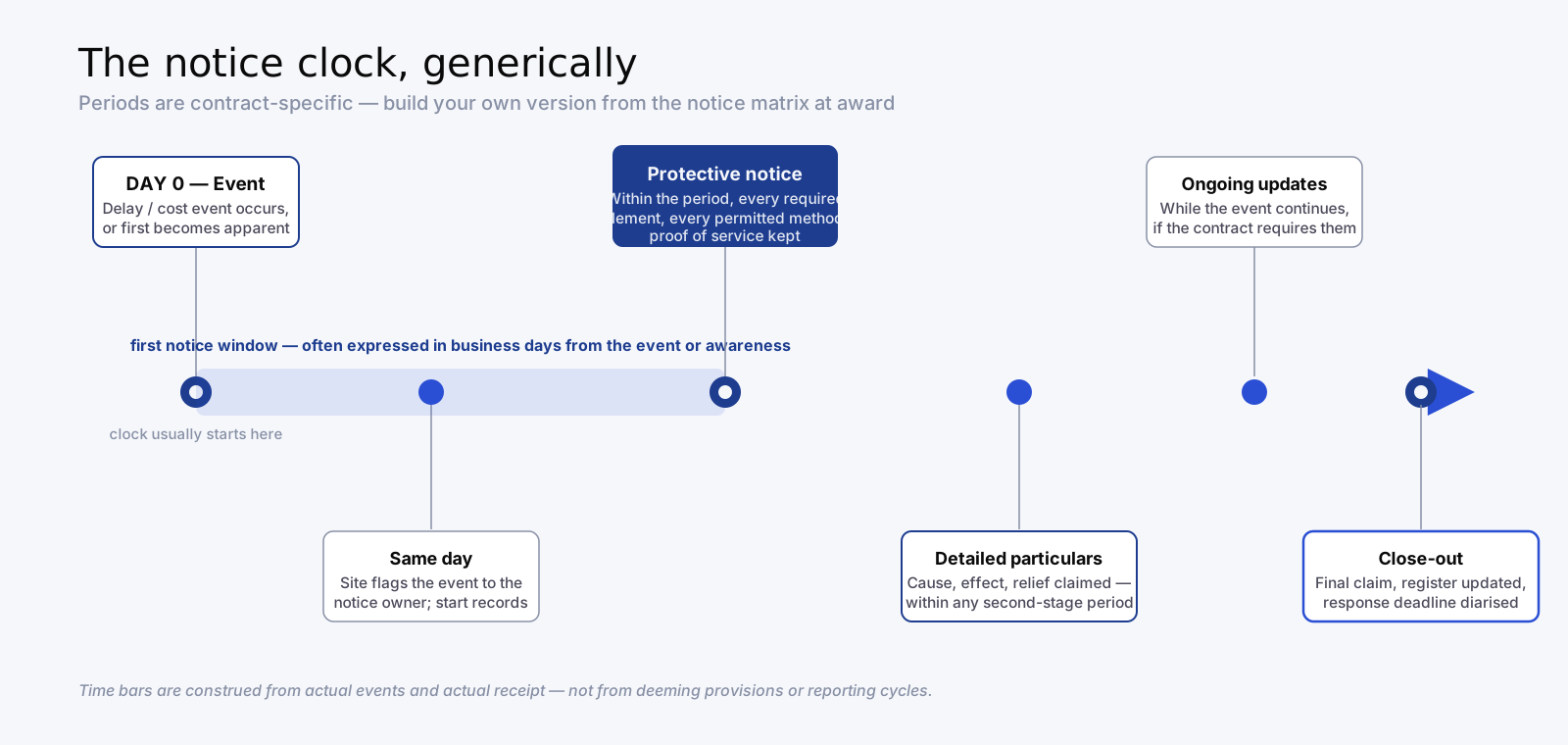
- Run the clock from the event, not the meeting. Time generally runs from the event or from awareness of it — not from when the monthly report is written. Site teams need a same-day habit of flagging candidate events to whoever owns notices.
- Serve protective notices early and cheaply. When in doubt, notify. A short, compliant notice that preserves entitlement costs an hour; the alternative can cost the claim. Do not wait for full particulars if the contract allows an initial notice followed by detailed substantiation.
- Match the content to the clause. Draft notices against the contractual checklist, element by element — Rimfire shows that omitting one required element can invalidate the lot. Address cause, effect, the relief claimed, and any matters the clause requires you to confirm.
- Control the delivery mechanics. Serve by every permitted method, to the named addressee, and keep proof. Deeming provisions and notice clauses are construed exactly; service arguments are won and lost on transmittal records.
- Keep a live notice register. Every notice issued and received, with dates, response deadlines and status, reviewed weekly. Incoming notices matter as much as outgoing — your counterparty's compliance failures are part of your commercial position too.
- Treat time bars as a two-way asset. A disciplined respondent should test every claim it receives against the notice regime before engaging on merits. Entitlement-side discipline and defence-side scrutiny are the same skill.
Key takeaways
- Australian courts enforce condition-precedent notice regimes as written; harshness is not a defence (CMA Assets).
- Content compliance matters as much as timing — a notice missing a required element fails (Rimfire Energy).
- The prevention principle rarely rescues a contractor that let an available EOT mechanism lapse (Turner v Austotel); Gaymark is an outlier, not a strategy.
- A superintendent's unilateral power to extend time may have to be exercised impartially even after a time bar (Peninsula Balmain) — check whether your contract has modified it.
- Victoria's 2026 reforms soften unfair time bars only in proceedings under the Victorian security of payment regime; they change nothing about notice discipline on site.
- The reliable protection is systematic: a notice matrix, protective notices, element-by-element drafting, controlled service, and a live register.
This article is general information only and is not legal advice. For advice on a specific contract or dispute, seek legal counsel or contact Sumit Consulting for commercial and claims advisory support.