News & Insights · 1 July 2026 · 5 min read
Kwik Flo: No Second Bite at Adjudication
An adjudicator ruled they had no jurisdiction. The claimant simply re-applied to another one — and the Court of Appeal called it what it was.

What do you do when an adjudicator decides they have no jurisdiction over your payment claim? For one claimant, the answer was simple: withdraw the application, find a different authorised nominating authority, and run the same claim past a second adjudicator — who took a different view and awarded $1.2 million. The New South Wales Court of Appeal has now shut that route. Kwik Flo Pty Ltd v SE Ware Street Dev Pty Ltd [2026] NSWCA 9 holds that an adjudicator's ruling that they lack jurisdiction is itself a "determination" under the Building and Construction Industry Security of Payment Act 1999 (NSW) — and that re-agitating the same issue before a second adjudicator is an abuse of process.
The facts
In around March 2022, Kwik Flo and SE Ware Street Dev orally agreed to develop SE Ware's land at Fairfield together. The agreement was never put in writing, and the parties later disputed its terms. On Kwik Flo's version, it was to carry out and finance construction activities and obtain a construction certificate, with SE Ware paying 30 per cent of the costs of obtaining the certificate. Some preliminary work was done; the land remains undeveloped.
Kwik Flo served a payment claim and, in May 2025, lodged an adjudication application. SE Ware's response contended the claim fell outside the Act. The first adjudicator agreed: accepting SE Ware's account of the arrangement, the adjudicator held the contract fell within the s 7(2)(c) exclusion — consideration not calculated by reference to the value of work — and concluded there was no jurisdiction to determine the application.
Kwik Flo then purported to withdraw that application and lodged a fresh one with a different authorised nominating authority, arguing that the first adjudicator had made no "determination" at all. The second adjudicator saw no jurisdictional impediment, took a contrary view of the contract, and determined that $1.2 million was payable.
SE Ware went to the Supreme Court. Peden J held the first adjudicator's jurisdictional ruling was a determination, that s 17A permits withdrawal of an application only before a determination is made, and that the second application was an abuse of process; her Honour granted injunctive relief ([2025] NSWSC 1060). Kwik Flo appealed.
The issues
Two questions did the work. First, statutory: is an adjudicator's conclusion that they lack jurisdiction a "determination" under the Act — with the consequence that the application can no longer be withdrawn and re-lodged? Second, equitable: is running the same jurisdictional issue before a second adjudicator, with supplementary material, an abuse of process?
What the Court of Appeal held
The Court — Mitchelmore JA, Griffiths AJA and Price AJA, with Griffiths AJA writing the lead judgment — dismissed the appeal.
On the statutory question, "determination" was construed in context and by reference to the Act's purpose (at [60]–[63]). A construction that includes jurisdictional conclusions "is consistent with the SOP Act's clear general policy of preventing repetitive re-agitation of the same issues" (at [67]–[68]) — and it leaves a dissatisfied claimant with a remedy where the ruling is genuinely wrong: judicial review for jurisdictional error. The adjudicator had an incidental power to decide their own jurisdiction, all the procedural steps of a determination had been observed, and the ruling was what it appeared to be.
On abuse of process, the second adjudication re-agitated precisely the issues the first had decided. The primary judge was right to restrain enforcement (at [103], [105]–[106], [108]). It mattered that SE Ware had objected to the second application on exactly this ground, on the record, from the outset.
What this means in practice
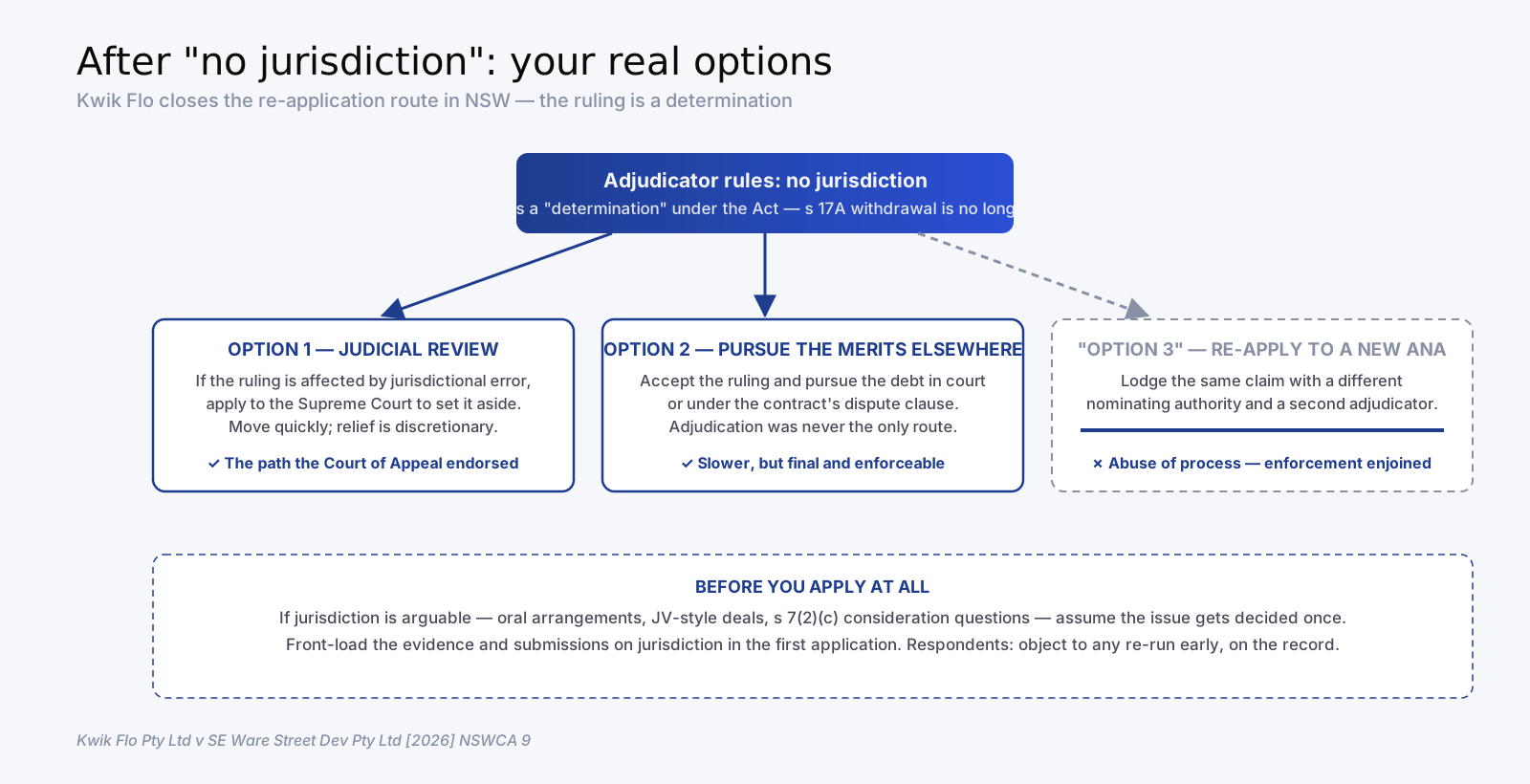
- An adverse jurisdictional ruling is a fork in the road, not a restart button. The claimant's options after a "no jurisdiction" determination are: accept it and pursue the claim in court or under the contract; or challenge the ruling by judicial review if it is affected by jurisdictional error. Lodging again with a different ANA is now, in NSW, a route to an injunction and a costs order.
- Pick your jurisdictional battleground before you apply. If there is a live question about whether your arrangement is a construction contract at all — oral joint ventures, development arrangements, cost-sharing deals — that question will likely be decided once. Front-load the analysis and the evidence in the first application, because there is no second adjudicator waiting if it goes wrong.
- Respondents: object early, on the record. SE Ware's express abuse-of-process objection to the second application, made at the time, featured in the Court's reasoning. A respondent who spots a re-run should say so in the adjudication response, not save the point for court.
- The one-shot logic of the Act keeps tightening. Alongside the single-claim-per-reference-date rule and the limits on withdrawal under s 17A, Kwik Flo completes a picture: the regime trades speed for finality at every node. Claimants get one properly prepared application; the discipline of getting it right the first time is not optional.
- Informal arrangements remain the danger zone. The underlying problem here was an oral development arrangement whose terms the parties could not agree on years later. Whatever else this case decides, it is another exhibit for documenting the commercial basis of any arrangement under which construction work gets done — because the s 7(2)(c) exclusion turns on terms that, unwritten, become a credibility contest.
Key takeaways
- An adjudicator's ruling that they lack jurisdiction is a "determination" under the NSW Act; the application cannot then be withdrawn and re-lodged (Kwik Flo [2026] NSWCA 9).
- Re-running the same jurisdictional issue before a second adjudicator is an abuse of process; enforcement of the second determination will be restrained.
- The remedy for a wrong jurisdictional ruling is judicial review — not a different nominating authority.
- Front-load jurisdictional analysis in the first application, and document informal arrangements before work starts.
This article is general information only and is not legal advice. For advice on a specific contract or dispute, seek legal counsel or contact Sumit Consulting for commercial and claims advisory support.