News & Insights · 10 June 2026 · 5 min read
Roberts Co v Sharvain: The $3.2M Deeming Clause That Couldn't Stop the SOPA Clock
A payment claim uploaded at 7pm on a Friday started the statutory clock that night — and the contract's deemed-service clause couldn't change it.

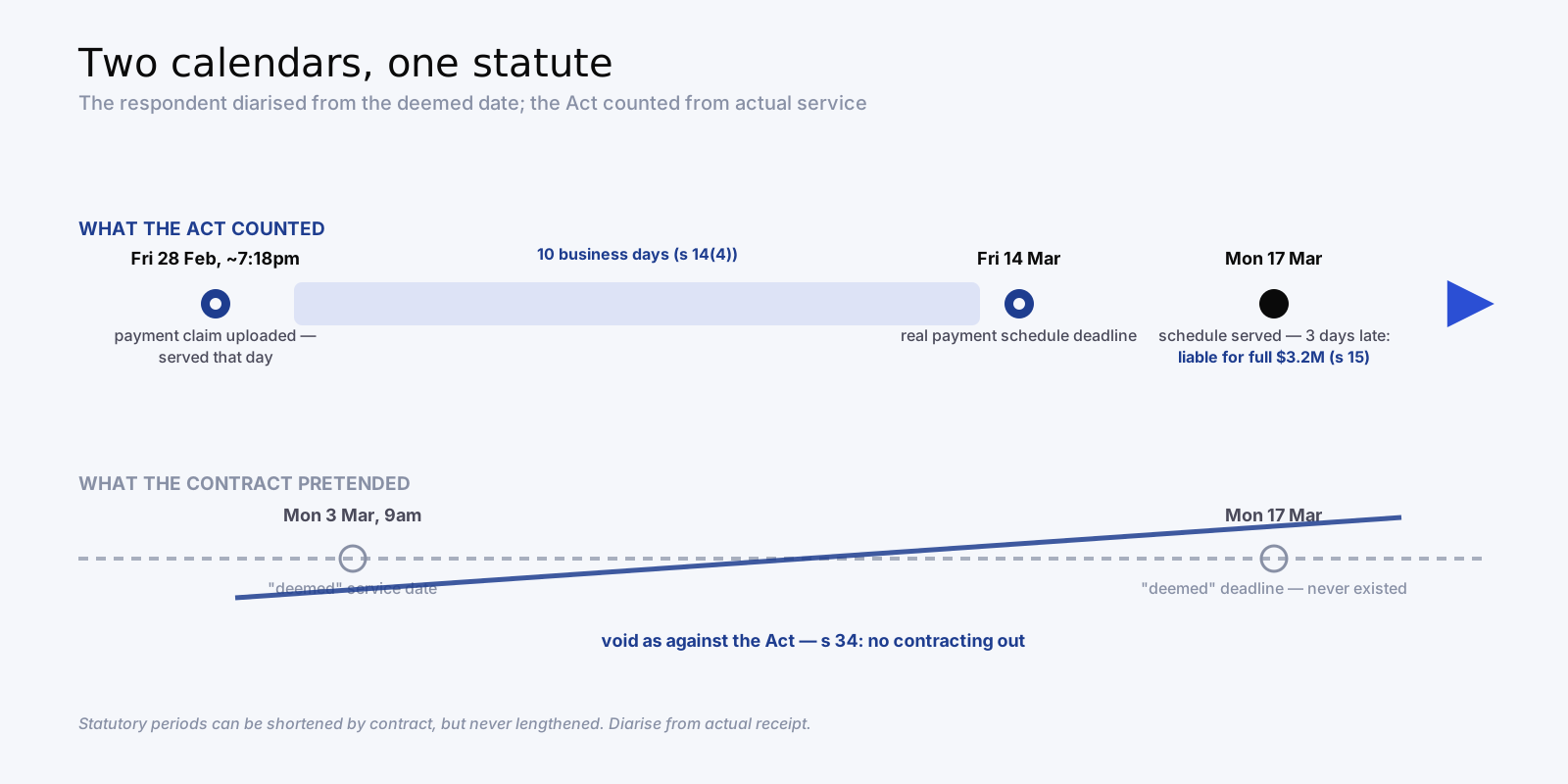
On a Friday evening in February 2025, a facade subcontractor uploaded a payment claim for $3,207,999.03 to the project's electronic payment platform at around 7:18pm. The subcontract said a notice given after 5pm was treated as received at 9am the next business day. The head contractor diarised its response from the Monday, and served its payment schedule on what it calculated was the last available day.
It was three days late. The result was judgment for the full claimed amount, affirmed on appeal: Roberts Co (NSW) Pty Ltd v Sharvain Facades Pty Ltd (Administrators Appointed) [2025] NSWCA 161. For anyone administering contracts under the Building and Construction Industry Security of Payment Act 1999 (NSW), this is the most practically important decision of 2025 — not because it changed the law, but because of how routinely the assumption it demolished appears in live contracts.
The facts
Sharvain Facades was Roberts Co's facade subcontractor. The subcontract contained a familiar deeming provision: a notice sent after 5pm on a business day "will be treated as having been given to and received by the addressee at 9am on the next business day."
Sharvain served its payment claim by uploading it to Payapps — the contractually prescribed system — on Friday 28 February 2025, after 7pm. Ten business days from 28 February expired on Friday 14 March. Counting instead from the "deemed" service date of Monday 3 March, the deadline would have been Monday 17 March — and that is the day Roberts Co provided its payment schedule.
Under s 14(4) of the Act, a respondent who fails to provide a payment schedule within time becomes liable for the claimed amount, recoverable as a debt under s 15. Sharvain — by then in administration — sued for the lot.
The issues
Two questions mattered. First: when was the payment claim "served" for the purposes of the Act — when it was actually uploaded and capable of retrieval on the Friday evening, or when the contract deemed it received? Second: if the deeming clause purported to govern that question, was it void under s 34 of the Act, which renders void any contractual provision that purports to "exclude, modify or restrict" the operation of the Act?
What the courts held
At first instance ([2025] NSWSC 606), Stevenson J held the claim was served on Friday 28 February and that the deeming clause was void under s 34 to the extent it operated otherwise — reasoning that if parties could deem after-5pm service into the next business day, they could equally "postpone the effect of service by any number of days", eroding the Act's strict timetable.
The Court of Appeal — Hammerschlag CJ in Eq, with McHugh JA and Griffiths AJA — unanimously dismissed the appeal. The lead judgment held that the time for providing a payment schedule is calculated under the Act from the date of actual service, independently of contractual provisions about when notices are taken to be received. Consistent with the Act's policy of rapid resolution of payment disputes, the statutory period can be contractually shortened — but not lengthened. Service happened on the Friday: the claim was uploaded to the prescribed platform and capable of retrieval that evening, and the law does not recognise fractions of a day.
The same logic has now landed in Western Australia: in Martinus Rail Pty Ltd v Co-operative Bulk Handling Ltd [2025] WASC 373, a payment claim emailed on a Saturday was held to be given that day, a contractual next-business-day deeming clause notwithstanding — with the respondent's schedule late as a consequence under the WA Act.
What this means in practice
The deeming clause in this contract was not exotic. Substantially identical provisions sit in thousands of live Australian construction contracts, and contract administrators rely on them daily for ordinary notices. The decision draws a hard line: those clauses may still work for contractual notices, but they do not move statutory clocks.
- Diarise from actual receipt, always. The payment schedule deadline runs from the day the claim actually arrives — including a 7pm Friday upload, a Saturday email, or a Christmas Eve transmission (subject to the Act's business-day definitions). The contract's service provisions are irrelevant to that calculation.
- Treat after-hours claims as a known tactic, not an anomaly. A claimant gains nothing improper by serving late on a Friday — and a respondent who processes claims only on business-day mornings has built a structural three-day error into its system. Inbox and platform monitoring needs to capture the actual transmission date.
- Build the buffer into your process, not your interpretation. If your team needs ten business days to assess a claim, target day eight. The cases where this goes wrong are nearly always at the margin.
- Respond to every claim, even if you dispute its validity. A payment schedule costs little; a missed one under s 14(4) converts the entire claimed amount into a debt — here, $3.2M, with the respondent unable to raise its substantive defences in the recovery proceedings.
- Audit your contract templates. Deemed-service clauses should be reviewed against each state's security of payment legislation, and internal training should make explicit that the SOPA clock is statutory. The NSW and WA decisions together suggest every Australian jurisdiction will take the same approach.
Key takeaways
- Deemed-service provisions cannot extend the time for a payment schedule under the NSW Act; time runs from actual service (Roberts Co v Sharvain [2025] NSWCA 161).
- The statutory period can be shortened by contract, but never lengthened.
- WA has reached the same position (Martinus Rail [2025] WASC 373).
- A late schedule means liability for the full claimed amount under s 14(4) — the most expensive administrative error in NSW construction.
- Fix the process: diarise from actual receipt, monitor after-hours service, respond early, respond always.
This article is general information only and is not legal advice. For advice on a specific contract or dispute, seek legal counsel or contact Sumit Consulting for commercial and claims advisory support.