News & Insights · 3 June 2026 · 6 min read
Pafburn in the High Court: The Non-Delegable Duty That Reshaped NSW Defect Claims
A 4:3 High Court split leaves developers and head contractors wearing the whole of a defects claim — and chasing everyone else by cross-claim.

If you developed or head-contracted a defective building in New South Wales, you can no longer point at your subcontractors and consultants to dilute the claim. That is the practical effect of Pafburn Pty Limited v The Owners – Strata Plan No 84674 [2024] HCA 49, where a 4:3 majority of the High Court held that a claim for breach of the statutory duty of care under the Design and Building Practitioners Act 2020 (NSW) is not apportionable. The defendant who supervised or controlled the work answers for the whole of the loss — and recovers from others, if at all, by cross-claim.
For commercial teams, this is not an academic point about statutory construction. It rewrites who holds the risk, who funds the litigation, and who carries the insolvency exposure of everyone further down the chain.
The facts
The owners corporation of a strata apartment building in North Sydney sued two parties over alleged defects: Pafburn Pty Ltd, the head building contractor, and Madarina Pty Ltd, the developer and former owner of the land. The claim was brought under s 37 of the Design and Building Practitioners Act 2020 (NSW) — the duty, introduced in 2020 with retrospective reach, to exercise reasonable care to avoid economic loss caused by defects arising from construction work.
The defendants pleaded a proportionate liability defence under Part 4 of the Civil Liability Act 2002 (NSW), naming nine alleged concurrent wrongdoers — among them the architect, certifiers, product manufacturers and installers, subcontractors and the local council. If the defence held, the owners would have had to pursue each wrongdoer for its slice of the loss, bearing the risk that any of them had disappeared or become insolvent.
At first instance, Rees J declined to strike out the defence. The Court of Appeal struck it out ([2023] NSWCA 301). The High Court granted special leave and, on 11 December 2024, dismissed the appeal by the narrowest of margins.
The issue
The question was whether a s 37 claim is an "apportionable claim" under Part 4 of the Civil Liability Act. The answer turned on the interaction of three provisions: s 39 of the DBP Act, which says a person who owes the s 37 duty "is not entitled to delegate that duty"; s 5Q of the Civil Liability Act, which determines liability for breach of a non-delegable duty "as if" the defendant were vicariously liable; and s 41(3) of the DBP Act, which makes the statutory duty regime "subject to" the Civil Liability Act.
What the High Court held
The majority — Gageler CJ, Gleeson, Jagot and Beech-Jones JJ — reasoned that because Pafburn and Madarina supervised or controlled the whole of the construction work, their s 37 duty extended, as the majority put it at [52], "to all defects in or related to that building arising from all construction work". The duty being non-delegable under s 39, their liability fell to be determined under s 5Q as if they were vicariously liable for the people who actually performed the work. Vicarious-style liability sits outside the proportionate liability regime — so the claim is not apportionable. The developer and head contractor are liable for the whole of the owners' loss, and their remedy against the architect, the certifier and the subcontractors is to cross-claim.
Three judges — Gordon, Edelman and Steward JJ — dissented, emphasising the practical consequences of concentrating the entire liability on the developer and head contractor. The closeness of the split matters: the construction adopted was genuinely contestable, and the legislature could intervene. But for now, the law in New South Wales is settled.
The Supreme Court has since pressed the logic further: in Kapila v Monument Building Group Pty Ltd [2025] NSWSC 1306, s 37 claims were held non-apportionable even where the defendant performed the work itself without delegating any of it.
What this means in practice
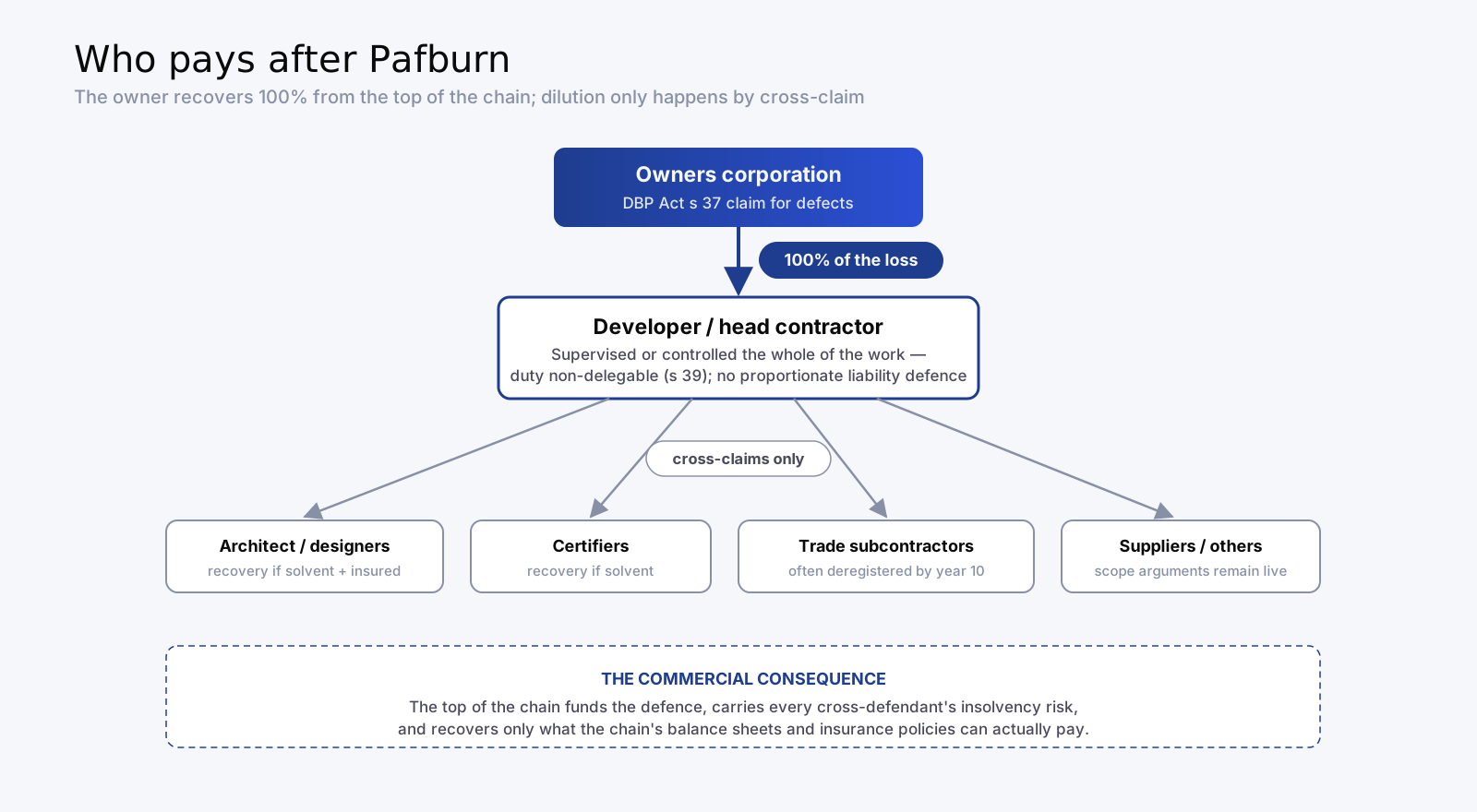
For developers and head contractors, the exposure profile has fundamentally changed. An owners corporation with a s 37 claim now has every incentive to sue only the parties at the top of the chain and let them sort out the rest. Three consequences follow:
- Cross-claims are now your only dilution mechanism. That means identifying every consultant, certifier and subcontractor whose work is implicated, early, and preserving claims against them — including watching limitation periods that run independently of the head claim.
- You carry the chain's insolvency risk. If the waterproofing subcontractor is deregistered by the time the defects emerge — a common scenario given the ten-year retrospective reach of the DBP Act duty — its share of the liability stays with you. Counterparty financial standing at procurement is no longer just a delivery question; it is a ten-year liability question.
- Contractual indemnities and security from subcontractors matter more, as does the adequacy and longevity of subcontractors' professional indemnity insurance. A right of recovery is only as good as the balance sheet or policy behind it.
For subcontractors and consultants, Pafburn is not a free pass. The pressure simply arrives by cross-claim instead of direct claim, and Kapila shows the courts will not confine Pafburn narrowly. Parties who performed discrete trade work without supervising or controlling the broader works may still have arguments about the scope of their own s 37 duty — that boundary remains live.
For everyone pricing risk: defect claims in NSW now concentrate rather than fragment. Expect that to show in insurance premiums, in developers' and builders' subcontract terms (broader indemnities, longer document-retention requirements, parent company guarantees), and in how aggressively top-of-chain parties manage quality records during delivery. The cheapest mitigation remains the oldest one — supervision and inspection records that demonstrate the care actually taken, trade by trade, while the work is open.
Key takeaways
- Pafburn [2024] HCA 49 holds that DBP Act s 37 claims against parties who supervised or controlled the whole of the work are not apportionable; liability is effectively non-delegable (4:3 majority).
- Owners can recover 100% from the developer or head contractor, who must then cross-claim against consultants and subcontractors — and who wears their insolvency risk.
- Kapila [2025] NSWSC 1306 extends the logic to defendants who did the work themselves.
- Practical responses: early cross-claim strategy, subcontractor financial and insurance due diligence, stronger indemnity and security packages, and disciplined supervision records throughout delivery.
This article is general information only and is not legal advice. For advice on a specific contract or dispute, seek legal counsel or contact Sumit Consulting for commercial and claims advisory support.