News & Insights · 15 June 2026 · 5 min read
EnerMech v Acciona: Clawing Back a Called Bank Guarantee Through SOPA
The NSW Court of Appeal confirmed a payment claim doesn't have to be 'for construction work' — opening adjudication as a fast route to recover called security.

The conventional wisdom about unconditional bank guarantees was simple: whoever holds the cash holds the leverage. A principal or head contractor that called on security could expect to keep the proceeds while the underlying dispute ground through litigation — often for years. EnerMech Pty Ltd v Acciona Infrastructure Projects Australia Pty Ltd [2024] NSWCA 162 punctured that assumption in New South Wales: a subcontractor recovered called guarantee proceeds within months, using nothing more exotic than a payment claim under the Building and Construction Industry Security of Payment Act 1999 (NSW).
The facts
EnerMech was engaged under a June 2020 subcontract for electrical installation works on the WestConnex M4-M5 Link project in Sydney, contracting with an unincorporated joint venture of Acciona, Samsung C&T and Bouygues. As security, EnerMech provided an unconditional undertaking from HSBC for $9,230,157.40.
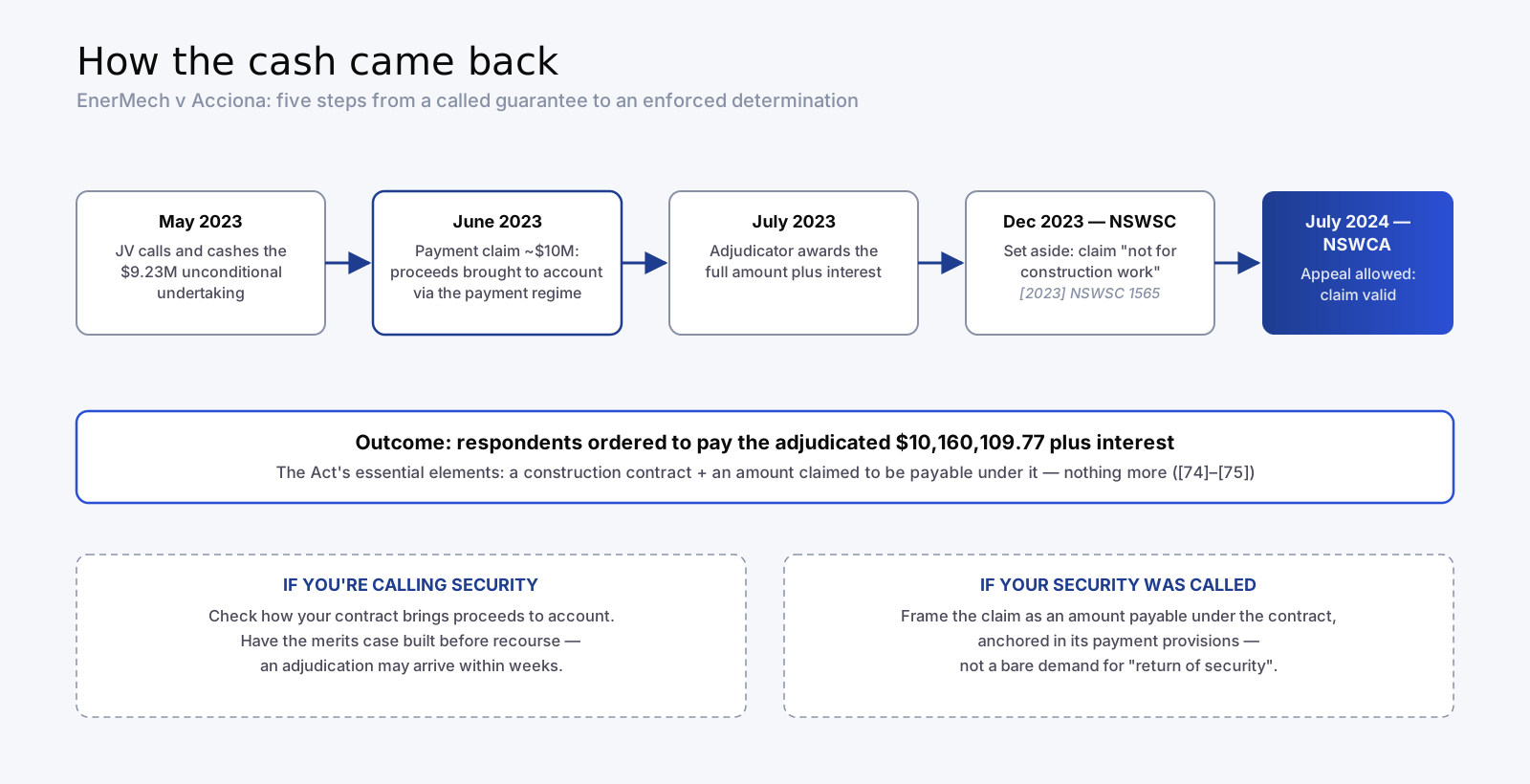
In May 2023, following alleged breaches by EnerMech, the joint venture called on and cashed the guarantee in full. The following month, EnerMech served a payment claim for just over $10M — a modest amount for recent work and a variation, but predominantly the $9.23M guarantee proceeds, brought to account through the subcontract's payment reconciliation regime. An adjudicator awarded EnerMech the full amount.
The joint venture had the determination set aside at first instance: Stevenson J held the claim was in substance one for repayment of security proceeds, not a claim "for construction work", and so could not be a valid payment claim ([2023] NSWSC 1565).
The issue
Does the Act require, as a condition of validity, that a payment claim be "for" construction work (or related goods and services)? Or is it enough that the claim asserts an amount payable under a construction contract — whatever the components of that amount?
What the Court of Appeal held
The Court of Appeal — Meagher JA, Basten AJA and Griffiths AJA — allowed EnerMech's appeal. The Act's text does not require that a payment claim be "for construction work"; the essential elements are a construction contract and a claimed amount said to be payable under it. As the Court put it, given the Act's objects, structure and "spare language, there is little scope for implying unstated conditions as essential to the validity of a payment claim" (at [74]), and "[a]lternative characterisations of a claim provide an uncertain basis for identifying an implied condition of validity" (at [75]).
The claim asserted an amount owed under the contract's payment regime — which brought the guarantee proceeds into the reconciliation — and was therefore valid. Whether the adjudicator's reading of the contract was right or wrong was beside the point: an error of that kind is not jurisdictional, and after Probuild, non-jurisdictional error is immune from review. The joint venture was ordered to pay the adjudicated amount of $10,160,109.77 plus interest.
The decision is reported at (2024) 115 NSWLR 56 and, as at mid-2026, stands as the law in NSW — no High Court appeal has emerged from the published special leave records.
What this means in practice
For principals and head contractors, recourse to security is no longer the end of the conversation. The traditional calculus — call the bonds, hold the cash, negotiate from strength — now has to price in the prospect that the other side reverses the cash position through adjudication within weeks. Before calling security on a NSW project:
- Read your own payment regime first. EnerMech succeeded because the subcontract's reconciliation provisions arguably brought security proceeds to account in the payment calculation. How your contract characterises called proceeds — a standalone right, or an amount within the payment machinery — now directly affects whether they can be clawed back via a payment claim.
- Expect the adjudication and prepare for it. If a call is contestable, assume a payment claim follows within the month. The merits work — substantiating the underlying breach, delay or cost entitlement that justified the call — needs to exist before recourse, not after, because adjudication timeframes will not wait for it.
- Weigh alternatives to bank guarantees at procurement. Commentary since the decision has noted that parties wanting security genuinely beyond the Act's reach may prefer instruments such as parent company guarantees, which cannot be converted to cash and reconciled through a payment claim.
For subcontractors and contractors whose security has been called, EnerMech provides a rapid, comparatively cheap recovery route — but it is technical. The claim must be framed as an amount payable under the contract, anchored in the contract's own payment provisions; a bare demand for "return of our security" invites the characterisation fight EnerMech won on its facts. This is precisely the kind of claim to prepare carefully rather than quickly, notwithstanding the speed of the regime it travels through.
For both sides: the decision continues the courts' broader message that the SOPA regime means what it says and resists implied limitations. Leverage built on assumptions about what the Act "surely can't do" keeps proving expensive.
Key takeaways
- A NSW payment claim need not be "for construction work" — it must claim an amount payable under a construction contract (EnerMech [2024] NSWCA 162; (2024) 115 NSWLR 56).
- Called bank guarantee proceeds were validly claimed back through the contract's payment reconciliation — $10.16M returned by adjudication enforcement.
- Calling security no longer secures the cash position; build the merits case before recourse and expect a counter-claim through SOPA.
- Drafting matters on both sides: how the contract brings security proceeds to account determines the claw-back route.
This article is general information only and is not legal advice. For advice on a specific contract or dispute, seek legal counsel or contact Sumit Consulting for commercial and claims advisory support.